


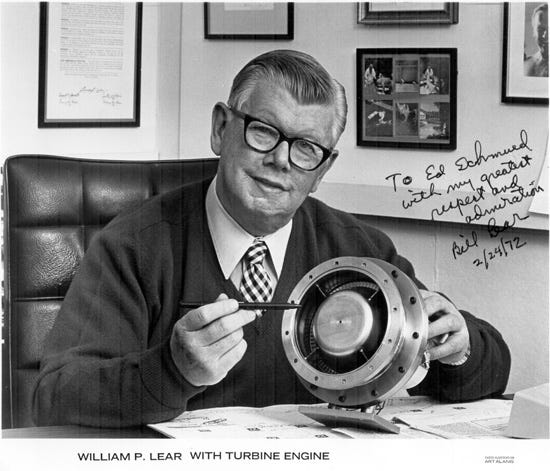
William Powell Lear left school after the eighth grade, lied about his age to join the United States Navy at sixteen, and spent the rest of his life proving that formal education is no prerequisite for engineering judgement. Born in Hannibal, Missouri, on 26 June 1902, to a carpenter father and a mother who would eventually leave both of them, Lear grew up shuttled between relatives in Iowa and Chicago. What he lacked in domestic stability he compensated with an apparently limitless capacity for absorbing how things worked and an even greater capacity for deciding they could work better.
His education was the shop floor. As a teenager, he fixed flat batteries, repaired radios, and taught himself Morse code from library books. In the Navy, he trained as a radio operator and came out with enough practical knowledge to talk his way into engineering positions with companies whose other engineers held proper degrees. The pattern that would define his entire career was already in place before he turned twenty: walk into a room, understand the problem faster than anyone else in it, and build something that solves it.

Radio, Motorola, and the Art of Simplification
Lear’s first invention of lasting consequence was the car radio. Working with his friend Elmer Wavering in Quincy, Illinois, he built a prototype receiver compact enough to fit inside an automobile dashboard, a problem that had defeated larger and better-funded engineering teams. They systematically identified and eliminated each source of electrical interference until the radio received a clear signal with the engine running. The two met Paul Galvin of the Galvin Manufacturing Corporation at a radio convention in Chicago and joined his company in 1930 to bring the design to production. Galvin, who could not afford a booth at the Radio Manufacturers Association show in Atlantic City, parked his Studebaker at the entrance to the pier and demonstrated the radio to passing attendees. He returned to Chicago with enough orders to keep the company alive, and named the product “Motorola,” combining “motor” with the then-popular suffix “ola” from Victrola. The company eventually took the product’s name as its own.
Lear moved on almost immediately. Within months he was building B-battery eliminators, then miniaturised radio coils using Litz wire, braided from many fine strands to increase surface area and conductivity at radio frequency. The coils were a quarter of the size of anything the industry had seen. Zenith ordered 50,000 of them. Lear traded that business for a stake in Galvin’s company, then moved on again. The speed at which he abandoned one finished product for the next unsolved problem would become both his defining strength and, eventually, a recurring vulnerability.
What made him different from other prolific inventors was not the range of his interests but his method of working. Lear was a bench-level engineer who happened to run companies. He designed circuits and layouts himself, then assembled prototypes with his own hands. When Bill Grunow of the Grigsby-Grunow-Hinds Company had 60,000 defective B-battery eliminators sitting in a warehouse, Lear did not send a memo. He went to the factory floor, diagnosed the problem, and fixed it. Grunow hired him on the spot. In 1941, his rate of filing new patent applications exceeded that of Thomas Edison at the height of Edison’s career.
Aviation Instruments and the F-5 Autopilot
In 1931, Lear bought his first aeroplane, a Fleet biplane. Two and a half hours of instruction later, he soloed. His first cross-country flight to New York went badly. Navigation was haphazard, instruments were unreliable, and the experience convinced him that aviation electronics needed the same treatment he had given consumer radio: make it smaller, make it lighter, make it actually work.
He founded the Lear Avia Corporation in 1934 to build radio and navigational equipment for aircraft. Within five years, more than half of all privately operated aeroplanes in the United States carried Lear equipment. His devices were valued by pilots not for their sophistication but for their simplicity of operation and their reliability, which came from the hours Lear spent in hangars and on flight lines, watching pilots interact with instruments, noting where their hands went, where their eyes tracked, and where the existing equipment forced them into unnecessary workload. He then went back to the workbench and eliminated every step that did not need to be there.
During the Second World War, Lear’s factories manufactured cowl-flap motors and precision instruments for Allied aircraft, filling more than 100 million dollars in defence orders. After the war, he turned to automatic flight control. The F-5 autopilot, which he developed for use in small fighter aircraft, was a miniaturisation achievement that earned him the Collier Trophy in 1949, presented by President Truman. By the mid-1950s, more than 100,000 F-5 autopilots had been installed across military and civil aviation, including on the French Caravelle jetliner. The City of Paris awarded him its Great Silver Medal for the first fully automatic aircraft landing system.
The approach never changed. Find the problem that prevents a device from being practical, then work at it physically until it does what it is supposed to do, at a size and cost that makes it producible. Lear was not a theoretician who derived solutions from first principles; he was a workshop engineer who iterated through hardware.
From Swiss Fighter to Business Jet
By the late 1950s, Lear was wealthy, restless, and convinced that the world needed a small, fast jet aircraft priced within reach of businesses rather than governments. The Lockheed JetStar and North American Sabreliner existed, but they were large, expensive, and aimed at corporate fleets with military-style budgets. Lear wanted something lighter, faster, and cheaper.
His board of directors at Lear, Incorporated disagreed. Their reasoning was straightforward: no other aircraft manufacturer was pursuing a low-cost business jet, which meant the market probably did not exist. Lear sold his stake in the company and struck out on his own.
In Switzerland, the Flug- und Fahrzeugwerke Altenrhein had developed the FFA P-16, a single-engine ground-attack fighter tailored for operations from short mountain runways. The Swiss government had ordered a hundred of them but cancelled the contract after two prototype crashes, despite the cause being a relatively minor hydraulic fault. The P-16’s multi-spar wing structure, robust landing gear, and compact dimensions represented exactly the kind of engineering foundation Lear needed. His son, Bill Lear Jr., test-flew the P-16 in Switzerland and reported favourably on its handling qualities.
Lear founded the Swiss American Aviation Corporation in 1960, recruited several of the P-16’s original engineers, including chief designer Dr. Hans Studer, and hired American designer Gordon Israel, who had previously worked on Grumman fighters and on Lear’s own Learstar conversion of the Lockheed Lodestar. Israel, who was responsible for the distinctive wedge-shaped nose and the aircraft’s overall appearance, worked alongside Studer, who adapted the P-16’s wing aerodynamics for the new configuration. Lear himself had no illusions about his role in the engineering; his contribution was the conviction that the whole thing could be done at all, and the money to prove it.
The project began with plans for multinational manufacturing: wings built by FFA in Switzerland, fuselages by Heinkel in Germany, engines and avionics imported from the United States, final assembly back at FFA. This kind of distributed production, routine in the 2020s, was unheard of in 1961. Administrative friction in Switzerland eventually drove Lear to abandon the European arrangement. As Bill Jr. later put it, it took too long to get anything done in Switzerland despite the cheaper labour. Lear shipped all tooling and materials to Wichita, Kansas, renamed the aircraft the Learjet 23, and started building.
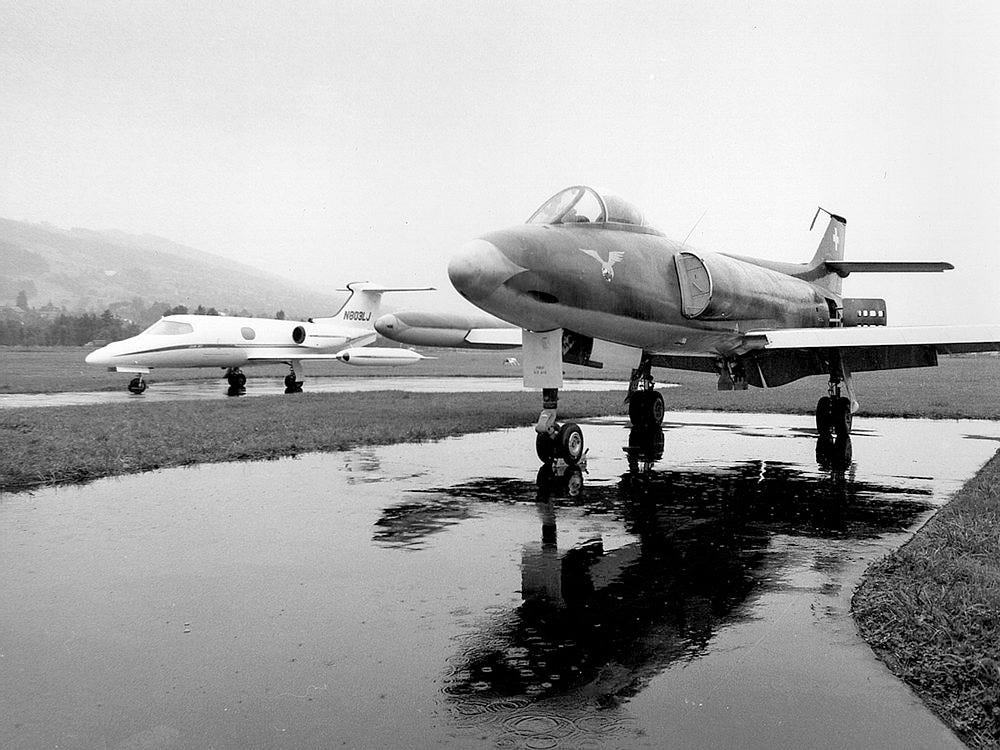
The first flight took place on 7 October 1963, nine months after work had begun at Wichita. The certification programme suffered a setback when the first prototype was destroyed in a belly landing during its 167th flight in June 1964, though both pilots survived. The insurance payment, ironically, provided the company with much-needed cash. The FAA certified a second prototype on 31 July 1964. The designation “23” was not arbitrary: the aircraft was designed to comply with FAR Part 23, the light aircraft regulations, which carried a maximum take-off weight limit of 12,500 pounds. Certifying under Part 23 rather than the transport category rules was a deliberate decision that reduced both development time and regulatory overhead.
The Learjet 23 carried up to eight passengers at 560 miles per hour and cost approximately 650,000 dollars fully equipped, some 400,000 dollars less than its nearest competitor. By the time of its delivery, 72 firm orders were already on the books. Frank Sinatra reportedly logged 1,500 hours on his Learjet in little over two years. Within a decade, the name “Learjet” had become synonymous with private jet travel in the way that “Kleenex” became synonymous with facial tissue. Seeing the Learjet’s success, Cessna, Dassault, and other manufacturers scrambled to produce their own business jets, but Lear enjoyed a complete monopoly for several years.
Lear himself was not an aerodynamicist and never pretended to be. He did not design the wing or calculate the flutter margins. What he did was stand in the factory at Wichita, watch the technicians work, and intervene when he saw a manufacturing process that could be simplified or a structural detail that added weight without adding function. When the narrow fuselage proved difficult to work inside during assembly, he found workers who could operate comfortably in the confined space. When someone complained that you could not stand up inside the cabin, he replied that you could not stand up in a Cadillac either. Weight reduction bordered on the obsessive; he once remarked that he would sell his grandmother to save one pound.
The Overreach
Lear’s willingness to pursue problems that the rest of the industry considered impossible was the same trait that eventually undid several of his later ventures, once applied to domains where intuition alone was not enough.
In 1967, he sold his stake in the Learjet Corporation to the Gates Rubber Company and founded Lear Motors Corporation to develop a steam-powered turbine engine for automobiles and buses. The project was motivated by genuine concern about automotive emissions, and the timing coincided with growing public awareness of air pollution. Lear claimed to have developed a proprietary working fluid called “Learium” with thermal properties superior to water, a claim that would have represented a thermodynamic anomaly. He later abandoned it, admitting that it was not chemically inert. He built a steam-powered transit bus, converted a Chevrolet Monte Carlo to run on his turbine system, and entered a steam-powered racer in the Indianapolis racing scene as the “Vapordyne.” None reached production. The venture consumed years and, by most accounts, tens of millions of dollars.
The Lear Fan followed a similar trajectory. The aircraft, a turboprop with twin engines geared together to drive a single pusher propeller, had a fuselage built entirely from composite materials rather than aluminium alloys, which was genuinely ahead of its time in the late 1970s. Lear died of leukaemia on 14 May 1978 before the aircraft was completed. His wife Moya, to whom he had been married since 1942 and who had been his business partner throughout, attempted to bring the Lear Fan to certification with the help of investors. The aircraft never received its FAA type certificate and was never produced.
The Bench and the Metal
Bill Lear accumulated over 150 patents across 46 years of work. He created the car radio, the eight-track tape cartridge, miniaturised autopilots, automatic landing systems, and the first mass-produced business jet. He failed at steam cars and composite turboprops.
The thread that runs through every successful Lear project is the same one that ran through the early radio work in Chicago: physical presence on the shop floor, personal engagement with the hardware, and an intolerance for unnecessary complexity. Lear did not manage by spreadsheet. He managed by standing next to the technician, watching the assembly, and asking whether it could be done with fewer parts, fewer steps, or fewer pounds. The people who worked with him at the Learjet plant in Wichita described the experience as relentless but never abstract. The problems were always about the object in front of you.
Steam power for automobiles was not a manufacturing problem to be solved at the bench but a thermodynamics problem, and no amount of workshop iteration would turn a working fluid with impossible thermal properties into a real substance.
The business jet, by contrast, was a perfect match for his method. A market existed that nobody had served, the technology was available but had never been packaged correctly, and the engineering talent, scattered across Switzerland, Germany, and the United States, needed someone to pull it together. That someone had to be willing to bet everything on the conviction that a cheaper, lighter, faster business aircraft would find buyers, and then to stand in the factory every day until the thing flew. Lear was sixty years old, had an eighth-grade education, and had spent his life building things with his own hands. He was the right person for the job.
His remains were cremated and scattered at sea. The aircraft that bear his name flew for sixty years of continuous production before Bombardier delivered the final Learjet 75 on 28 March 2022. Over 3,000 had been built. More than 2,000 remain in service.
If you find value in Engineering Airworthiness, consider subscribing for free.
If you think someone might benefit from it, feel free to share it.
References
[1] Boesen, V., “They Said It Couldn’t Be Done: The Incredible Story of Bill Lear,” Doubleday, 1971.
[2] Hamel, P.G. and Park, G.D., “The Learjet History,” Springer, 2022.
[3] Frickler, J., “Switzerland’s P-16: Father of the Learjet,” Air International, Vol. 40, No. 3, March 1991, pp. 139-146.
[4] William P. and Moya Olsen Lear Papers, The Museum of Flight Archives, Seattle.
[5] Fillingham, P., “Bill Lear Interview,” Penthouse, 1971.